A high-performing executive walks into the office. Her calendar is packed from dawn to dusk, her inbox is overflowing, and her colleagues admire how she “has it all under control. On the outside, she looks composed, competent, and successful.
But on the inside? She’s rehearsing tomorrow’s presentation for the fifteenth time, replaying a minor mistake from last week’s meeting, and wondering if she’s good enough for the role she’s already earned.
This isn’t an isolated story. It’s the experience of many high-achievers. The very traits that drive their success, ambition, high standards, and relentless problem-solving often come at a hidden cost: overthinking, perfectionism, and harsh self-judgment.
These inner patterns don’t just create stress; they quietly erode confidence, fuel imposter syndrome, and trap even the most accomplished professionals in cycles of fear and resistance. And the missing ingredient that can shift everything: Emotional safety.
Why do high-achievers overthink and self-judge?
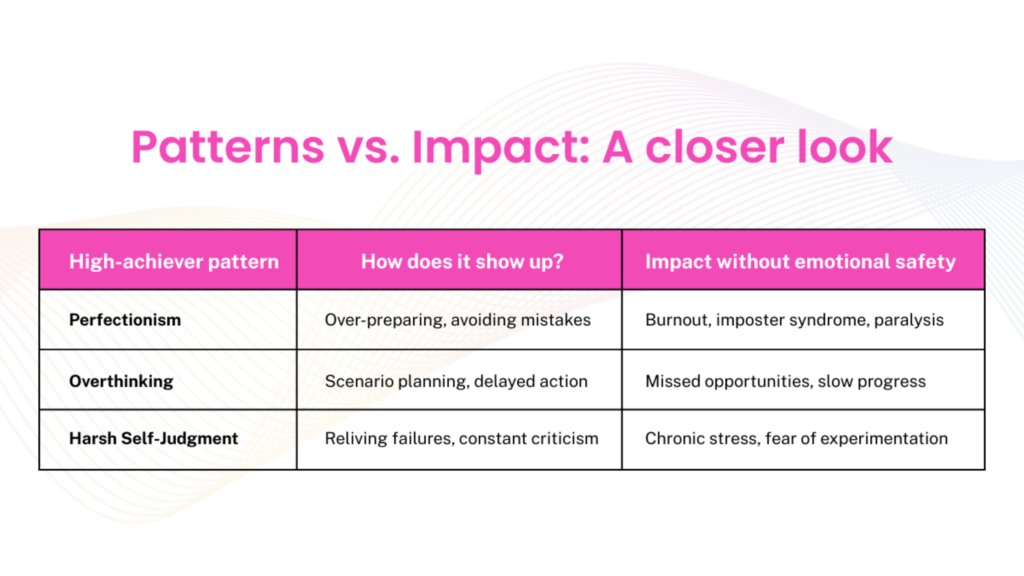
High-achievers are masters at strategy. They calculate the shortest distance to results, anticipate obstacles, and play out scenarios in their heads long before they unfold. At first glance, this looks like excellence. But when taken too far, it becomes:
- Overthinking: replaying every possible outcome until decisions feel paralyzing.
- Negative self-judgment: labeling every mistake as a personal failure rather than feedback.
- Perfectionism: setting standards so high that “good” is never enough.
These patterns don’t remain harmless mental habits. Over time, they show up as:
- Fear of failure.
- Resistance to trying new approaches.
- Imposter syndrome, the belief that success is luck, not ability.
And yet, most high-achievers double down on the same strategies: more control, more calculation, more pushing. Which only deepens the cycle. Letting go, might just seem too much to ask them.
What does emotional safety really mean?
Contrary to popular belief, emotional safety isn’t about lowering standards or “going easy” on yourself. It’s about creating an inner environment where curiosity, mistakes, and growth can exist without fear of constant judgment. When high-achievers cultivate emotional safety, they:
- Trust their inner knowing instead of second-guessing.
- Detach from results and focus on aligned action.
- Open themselves to learning, even when things don’t go as planned.
The results?
- More aligned and swift actions.
- Shorter bounce-back time after setbacks.
- Less emotional turmoil during challenges.
- Sustainable effectiveness that doesn’t burn them out.
Stories from the workplace
A client once confessed: “I don’t want to get angry at colleagues because I know it looks unprofessional. But no matter how hard I try, I end up exploding when people don’t follow my instructions.”
The real issue wasn’t his colleagues. It was the meaning he attached to their behavior: non-compliance equaled disrespect. And disrespect equaled invalidation. Without emotional safety, every missed instruction felt like a personal attack.
What shifts with safety?
- The ability to stay open instead of defensive.
- The curiosity to ask, “Why wasn’t this followed?” instead of assuming malice.
- The freedom to separate identity from outcome.
Another professional described her daily rhythm like this:
- Everything felt urgent.
- Meetings ran over time.
- Real work only began after hours.
- The market was so volatile that adapting felt impossible.
Her impatience wasn’t just about deadlines. It was about the suffocating sense that there was never enough space to pause, reflect, or prioritize. Without emotional safety, she couldn’t say “no” or “not now” without fearing judgment.
What shifts with safety?
- Trusting inner knowing about what truly matters.
- Courage to express boundaries.
- Space to pivot, adapt, and respond rather than react.
Why is clarity alone not enough?
Here’s the trap many high-achievers fall into: they seek clarity as the cure. They read books, attend workshops, and journal pages of insights. They understand their patterns intellectually.
And yet… the same cycles repeat.
Because clarity without emotional safety is like a map without the courage to walk the path. You can see the problem, but you can’t embody the solution. That’s why emotional safety is the missing link between knowing and becoming.
What becomes possible with emotional safety?
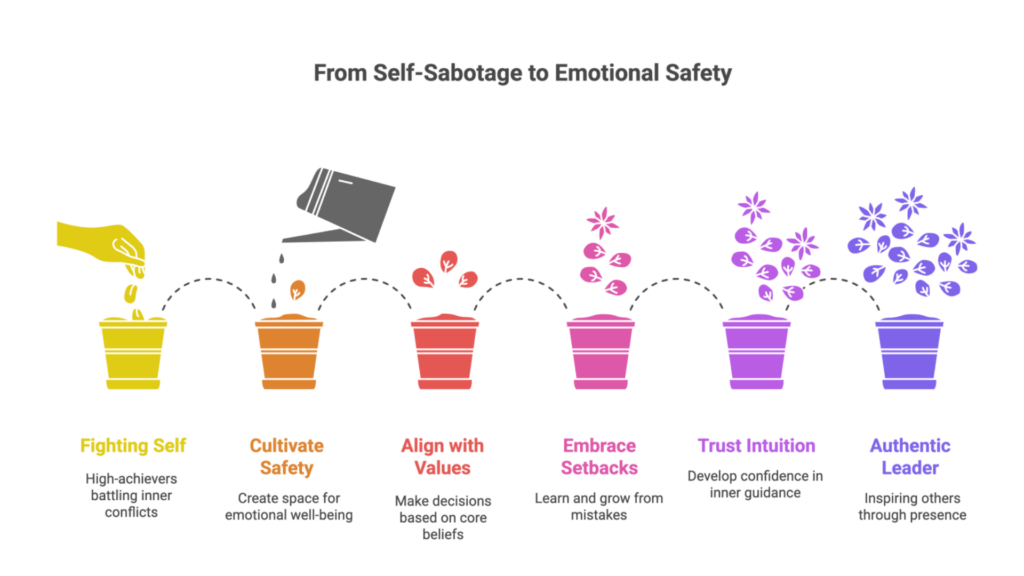
When emotional safety is cultivated, high-achievers stop fighting themselves and start flowing with life.
- Clarity without chaos: Decisions align with values, not fear.
- Resilience after setbacks: Mistakes become lessons, not labels.
- Inner trust: Confidence rooted in intuition, not external validation.
Authentic leadership: Presence replaces performance, inspiring trust in others.
How to start building emotional safety?
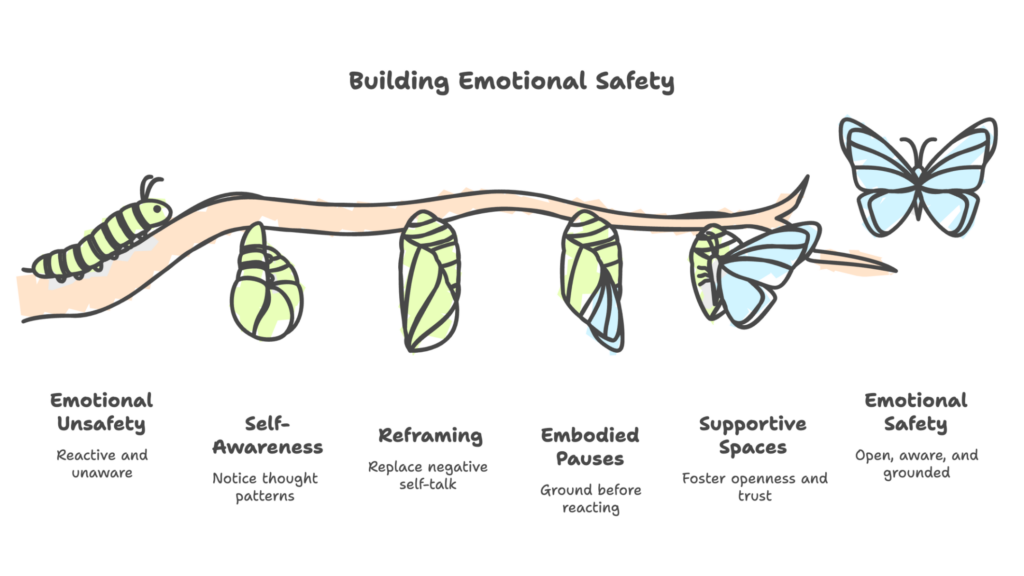
Creating emotional safety is less about drastic changes and more about consistent practices:
- Self-awareness rituals: Journaling, mindfulness, or daily check-ins to notice thought loops.
- Reframing setbacks: Replace “I failed” with “What can I learn here?”
- Embodied pauses: Breathwork or somatic grounding before reacting to triggers.
- Supportive spaces: Joining circles or working with coaches who foster openness without judgment.
These practices aren’t luxuries. They’re lifelines.
The invitation: From perfection to presence
High-achievers don’t need to abandon ambition. They need to anchor it in safety. With emotional safety, overthinking transforms into clarity, perfectionism softens into excellence, and self-judgment evolves into self-trust.
As one client put it: “I’m still achieving at the same level but now I’m sleeping better, reacting less, and my team says I feel more approachable. The difference? I finally feel safe within myself.”
This is the shift. Success stops being a performance and becomes a natural expression of wholeness.
Let’s continue the dialogue
What does emotional safety mean to you in your leadership or career?
Have you noticed how overthinking or perfectionism affects your decision-making?
Where does impatience or anger show up in your work life?
What would be different if you felt safe enough to pause, trust yourself, and respond from presence?
Share your thoughts in the comments. Let’s open this conversation because emotional safety isn’t a luxury for high-achievers. It’s the foundation of sustainable success.
-Authored by @Shuang-Min Chang